Quick answer: Florida land clearing should be planned around the next construction phase, not treated as simple vegetation removal. The right scope depends on what must remain, how equipment will enter and leave, how debris and stumps will be handled, how drainage will be protected, and what finished condition the site needs before excavation, utilities or foundations begin.
Clearing a residential lot for a house, addition, driveway or site improvement can include several different operations. A low bid may cover only brush removal, while another scope includes stump removal, hauling, rough grading and erosion-control measures. Those are not the same deliverable.
Florida land clearing at a glance
| Method / scope | Typical purpose | What to clarify |
|---|---|---|
| Brush cutting / mowing | Light vegetation and access | Does not remove major roots or stumps. |
| Forestry mulching | Reduce brush and smaller vegetation in place | Ask what material size is within scope and what remains afterward. |
| Clearing and grubbing | Remove vegetation, roots and stumps from construction areas | Often more appropriate where slabs, roads or utilities will be installed. |
| Haul-off | Remove debris from the property | Confirm trucking, disposal and loading are included. |
| Rough grading | Shape the site for drainage and the next trade | Confirm target elevations and whether compaction is included. |
1. Decide what should stay before equipment arrives
Mark the things that must remain before clearing begins. That can include specimen trees, fences, wells, septic components, survey points, utilities, drainage structures, neighboring improvements and protected areas.
A survey or site plan is especially useful when clearing will support a new house or addition. Removing the wrong vegetation or disturbing a boundary area can create a much more expensive problem than the clearing itself.
305 field note: A clean work zone starts with a defined keep/remove plan. Equipment operators should not have to decide in real time whether a tree, fence section or buried feature is supposed to remain.
2. Match the clearing method to what comes next
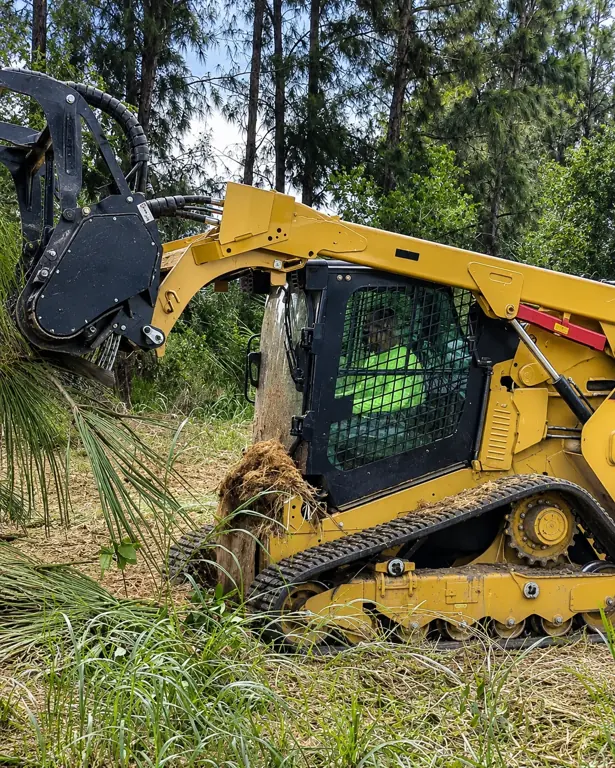
Forestry mulching can be useful for reducing brush and smaller vegetation, but a future building pad, driveway or utility trench may still require roots, stumps and unsuitable material to be removed from the actual construction area.
For a house pad or major site improvement, coordinate land clearing with excavation so the transition between vegetation removal and earthwork is clear.
Questions to ask
- Will stumps be cut flush, ground, pulled or excavated?
- Will roots remain beneath future slabs or pavement?
- Is mulch staying on-site or being removed?
- What happens to larger logs and vegetative debris?
- Is rough grading included?
- What condition will the site be left in for the next crew?
3. Plan equipment access before clearing
Heavy equipment needs a safe route to the work area. Narrow gates, overhead utilities, septic systems, soft shoulders, mature trees, neighboring structures and existing pavement can all affect how the job is approached.
Wet-season conditions matter too. Saturated soil can reduce traction, increase rutting and make restoration more difficult. In some cases the schedule or access plan should change rather than forcing equipment through unsafe or unstable ground.
4. Protect drainage while the site is disturbed
Removing vegetation changes how rain reaches and moves across the ground. A clearing plan should avoid creating uncontrolled runoff toward a street, neighbor, wetland, building pad or low area.
The Florida Department of Environmental Protection construction activity guidance is a useful statewide reference for stormwater responsibilities associated with disturbed land. Project-specific requirements depend on the size, location and jurisdiction.
Temporary stabilization, silt controls, stabilized entrances or drainage measures may be necessary before the permanent grade is established.
5. Understand the biggest land-clearing cost drivers
There is no single per-acre price that accurately describes every Florida lot. Cost can change significantly based on:
- density and diameter of vegetation;
- number and size of stumps;
- haul distance and disposal requirements;
- wet or soft ground;
- limited equipment access;
- rock, buried debris or old foundations;
- tree-protection requirements;
- erosion-control needs;
- amount of grading after clearing;
- whether debris can remain on-site;
- how much of the lot must be construction-ready versus simply opened up.
A useful quote should state the finished condition, not just the equipment and number of days.
6. Do not clear more land than the project needs
Removing unnecessary vegetation can increase erosion, restoration work and future maintenance. Clearing limits should reflect the actual building footprint, access, utility routes, drainage plan and required working room.
This is particularly important on residential properties where existing trees and landscaping may be part of the final design.
7. Coordinate clearing with utilities and site preparation
If the project includes new underground utilities, driveway work, drainage or a foundation, map those routes before the clearing layout is finalized. That can prevent clearing the same area twice and reduce conflicts between trades.
For projects moving directly into construction, see our Residential New Construction, Drain & Sewer and Excavation services.
What should a land-clearing quote include?
- defined clearing limits;
- trees or features to remain;
- equipment access assumptions;
- stump and root treatment;
- mulching versus haul-off;
- debris loading and disposal;
- rough grading or final grade responsibilities;
- erosion and stormwater controls when required;
- restoration of access routes or damaged areas;
- the condition the site will be in when the next trade arrives.
Florida land clearing questions
Is forestry mulching enough before building a house?
Not necessarily. Mulching can clear vegetation efficiently, but construction areas may still require stumps, roots, unsuitable material and organic soils to be removed before structural work or pavement begins.
Should land clearing happen before the survey?
Major clearing is easier to control when property lines, easements and the intended project layout are known. Limited access clearing may happen earlier, but permanent clearing limits should be based on reliable site information.
Can land clearing cause drainage problems?
Yes. Removing vegetation and reshaping the ground can change runoff patterns. Temporary and permanent drainage should be considered before the site is left exposed to heavy rain.
Do I need to remove every stump?
No. Stumps outside construction and access areas may be able to remain depending on the project. Stumps beneath future structures, paving, utilities or critical grading areas usually require a different approach.
See 305 land clearing in the field
Our Homestead land-clearing project documents forestry mulching, brush and vegetation removal, grapple-truck debris handling and a finished lot prepared for the next phase.
Clear the site for the project-not just for appearance
The best land-clearing plan starts with the final use of the property. 305 Underground Construction can review clearing, access, grading, excavation, drainage and the construction sequence together so the site is prepared for what happens next.
Request a site walk to define clearing limits, equipment access, debris handling and the required handoff condition for your Florida property.