
Quick answer: There is no universal “best” Florida roof. Asphalt shingles usually have the lowest initial cost, standing-seam metal generally costs more up front but offers strong durability, and tile delivers a distinct look and long service potential but adds structural weight and installation complexity. The right choice depends on the existing roof structure, coastal exposure, budget, maintenance expectations and how long you plan to own the home.
Florida roofing decisions should be made at the system level. The visible material matters, but so do the deck, underlayment, flashing, penetrations, ventilation, fasteners, edge details and roof-to-wall connections.
Shingle vs. metal vs. tile roofing in Florida
| Factor | Architectural shingles | Standing-seam metal | Tile |
|---|---|---|---|
| Up-front cost | Usually lowest | Usually higher | Usually higher |
| Weight | Relatively light | Relatively light | Much heavier |
| Maintenance | Periodic inspection and repair | Inspect seams, flashings and penetrations | Broken tiles and underlayment require attention |
| Florida storm concern | Wind rating and fastening matter | Panel attachment and detailing matter | Attachment, broken tiles and underlying system matter |
| Coastal exposure | Material and hardware selection matter | Coating and fastener compatibility matter | Tile itself handles sun well; metal components still matter |
| Structural review | Usually straightforward | Usually straightforward | Important because of weight |

What does a Florida roof replacement cost in 2026?
Planning estimates vary by roof size, pitch, tear-off complexity, deck condition, material, access and location. Current Florida pricing guides commonly place architectural shingles at the lower end, with standing-seam metal and tile substantially higher. These are planning ranges rather than quotes, and a contractor should inspect the property before using them for a budget.
A 2026 Florida pricing guide from Smart Roofing Calculator reports roughly $480-$700 per roofing square for architectural shingles, $1,000-$1,550 per square for standing-seam metal and $950-$1,500 per square for tile. A roofing “square” is 100 square feet of roof area, not floor area. Roof geometry, tear-off, decking, access and local requirements can move a project outside those ranges, so treat them as planning estimates rather than a quote.
1. Asphalt shingles: practical and widely used
Architectural shingles remain common because they balance price, appearance and installation familiarity. In Florida, the important questions are not just brand and color. Ask about wind rating, underlayment, nailing pattern, deck condition, flashings and edge details.
Shingles may make sense when:
- initial budget is a major priority;
- the roof structure is conventional;
- future repairs should remain straightforward;
- the homeowner wants a broad range of colors and profiles.
2. Standing-seam metal: durability with higher up-front cost
Standing-seam metal can offer strong durability and a clean architectural appearance. But the quality of the substrate, panel attachment, flashing, penetrations and trim matters as much as the panel itself.
Metal may make sense when:
- the homeowner prioritizes long-term durability;
- the roof geometry works well for standing-seam panels;
- coastal material compatibility is considered;
- the budget supports a higher initial investment.
305 field note: A metal roof should not be treated as a “forever roof” that never needs inspection. Penetrations, sealants, flashings, fasteners and transitions remain maintenance points even when the field panels are performing well.
3. Tile: long-lived appearance with structural considerations
Concrete and clay tile are common on Florida homes because of appearance and long-term durability, but tile systems are heavier and can be more complex to repair. The supporting structure, underlayment, flashing and attachment method should be reviewed as part of the system.
Tile may make sense when:
- the structure is appropriate for the added weight;
- the architectural style benefits from tile;
- the owner accepts higher replacement and repair complexity;
- the underlying roof system is detailed carefully.
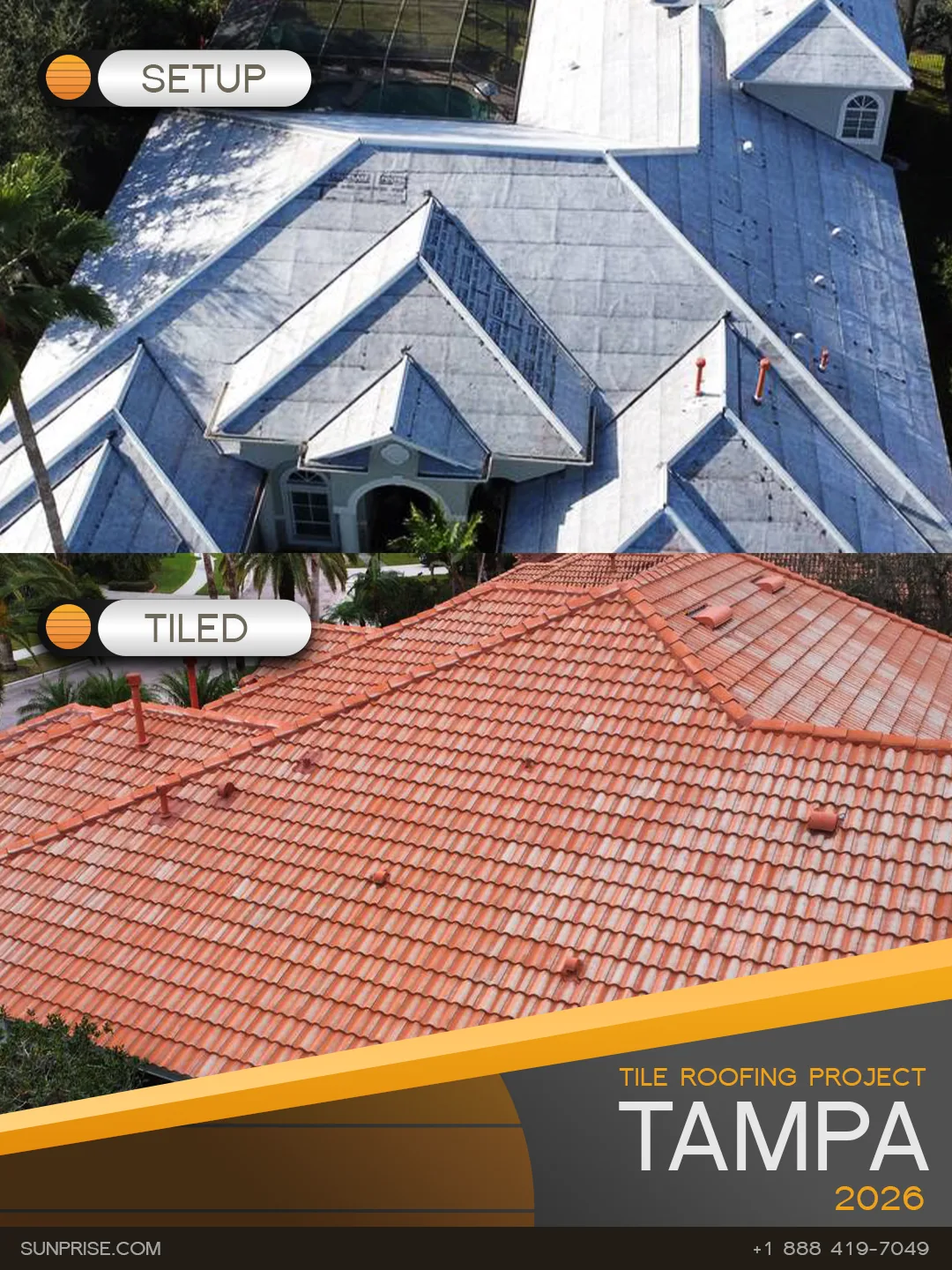
Roof material is only one part of the system
The Florida Hurricane Retrofit Guide emphasizes that reroofing creates an opportunity to inspect roof decking, fastening, secondary water protection, flashing and structural connections. That is why comparing only the visible roof material can miss important work.
Ask every proposal to address:
- tear-off and number of existing layers;
- deck inspection and repair method;
- underlayment system;
- flashing replacement;
- valleys and roof transitions;
- penetrations;
- ventilation;
- edge metal and drip edge;
- fastening/attachment method;
- cleanup and magnetic nail collection;
- permit and inspection responsibility.
What changes roofing cost most?
Roofing costs can move quickly because of:
- roof area and pitch;
- number of valleys, hips and penetrations;
- tear-off layers;
- damaged decking;
- material selection;
- access and staging;
- structural reinforcement;
- coastal/high-wind requirements;
- gutters, skylights and ventilation changes;
- temporary weather protection;
- permit and engineering needs.
How roofing should coordinate with remodeling and additions
If you are planning a room addition, new windows or a major remodel, roof work should be sequenced with those phases. New roof geometry, wall openings and water paths can all change how flashing and drainage should be handled.
305 Underground Construction performs residential roofing as part of a broader construction scope that also includes Windows & Doors, additions and Residential New Construction. That allows the roof to be evaluated as part of the structure instead of as an isolated finish.
Florida roofing questions
Which roof lasts longest in Florida?
Material longevity depends heavily on installation, maintenance, exposure and the underlying assembly. Tile and metal are often selected for long-term durability, while architectural shingles offer a lower initial cost and simpler replacement path.
Is metal always better than shingles?
No. Metal can provide durability and a long service horizon, but it costs more initially and must be detailed correctly. A well-installed shingle roof may be the better fit for a homeowner with a different budget or ownership horizon.
Can I install tile on any house?
Tile is significantly heavier than shingles or many metal systems. The structure should be evaluated before assuming a tile conversion is appropriate.
Should I replace windows before the roof?
There is no universal order. If both projects are planned, coordinate flashing, exterior finishes and access so one project does not damage or duplicate the other.
See a real Tampa metal-roof replacement
Our Metal Roof - Tampa project shows the before-and-after sequence: shingle tear-off, deck repair, high-temperature underlayment and standing-seam metal installation with custom flashing and seam work.
Choose the roof as part of the whole home
The right roof decision balances material, structure, water management, wind exposure, maintenance and budget. A site-specific inspection is more useful than choosing from material names alone.
Request a roofing site walk with 305 Underground Construction to review the existing roof, structural conditions and any remodeling or storm-hardening work that should be coordinated with the replacement.